What is AI in B2B marketing?
AI in B2B marketing is the use of machine learning inside everyday marketing tools and workflows – from lead scoring and bid optimisation to reporting and content repurposing. For most B2B teams it’s already embedded in the stack; in regulated industries the question isn’t whether to adopt it, but where it helps and where it introduces risk.
How is AI used in B2B marketing?
AI marketing is no longer something marketing teams experiment with on the side. For most B2B organisations, it already sits inside the tools they use every day. CRM platforms rely on predictive models. Paid media platforms adjust bids automatically. Email systems optimise send times, and analytics tools surface patterns in campaign performance.
Most teams are already using AI whether they actively chose to or not.
For companies operating in regulated sectors, the real question is not whether to adopt AI marketing, it is deciding where it helps and where it creates unnecessary risk.
Used carefully, AI improves the speed and consistency of marketing execution. Used without controls, it can introduce vague claims, compliance gaps and messaging that does not meet regulatory standards.
For regulated B2B teams, the goal is not automation everywhere. The goal is controlled use.
Where does AI already sit in the typical marketing stack?
Many of the tools B2B marketing teams rely on already use machine learning behind the scenes.
Lead scoring models inside CRM systems rank prospects based on behaviour and firmographic data. Paid media platforms optimise bidding automatically based on performance signals. Email platforms analyse engagement patterns to determine the best time to send campaigns.
Even search and SEO/AEO tools now rely on machine learning to identify keyword relationships, search intent and content gaps.
In other words, AI marketing is already embedded across the marketing stack. The difference now is that teams are beginning to apply it more deliberately.
Why must regulated industries approach AI differently?
Marketing in regulated industries operates under tighter constraints.
Claims must be accurate and clearly evidenced. Language needs to be precise. Data handling must follow defined governance rules. When mistakes happen, they carry legal and financial consequences.
This changes how AI can be used.
AI systems are very effective at analysing data and supporting repeatable tasks, but they are not capable of understanding regulation, context or accountability. Those responsibilities remain with the marketing team.
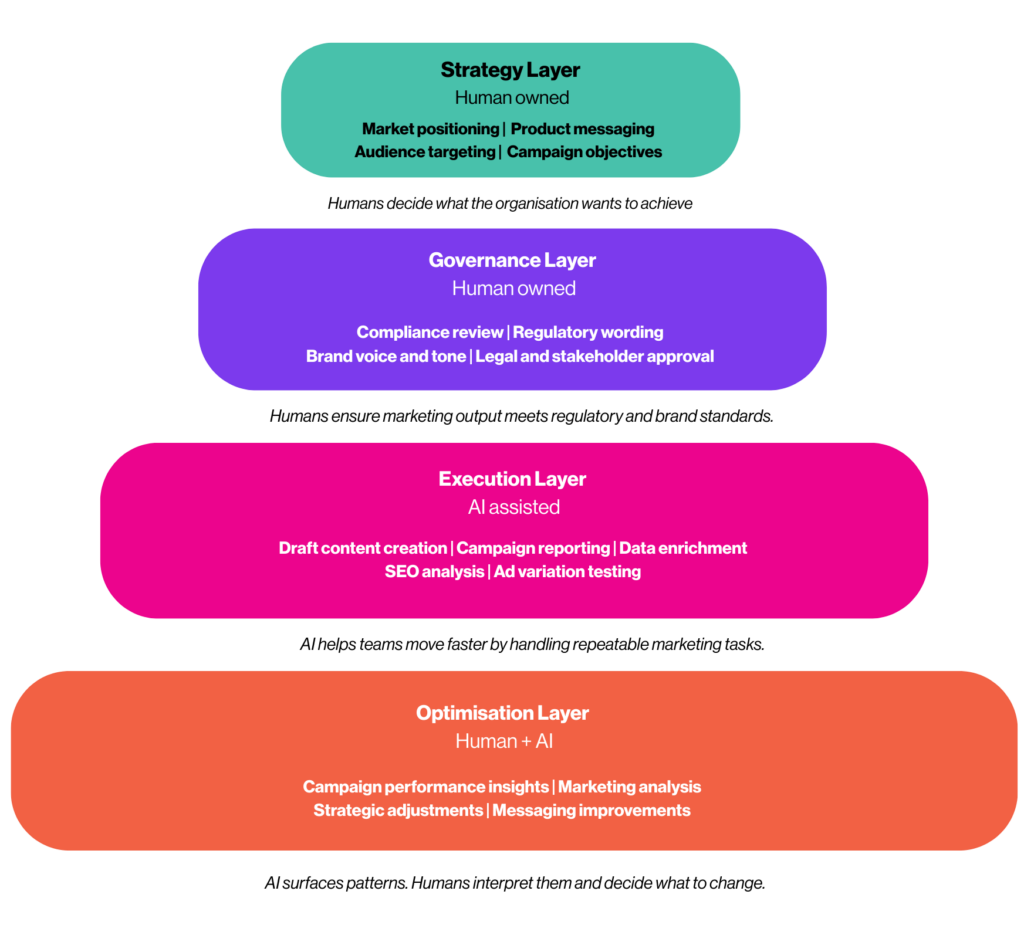
The most effective approach is to treat AI as operational support rather than decision maker. The technology accelerates execution. Humans remain responsible for judgement.
How are AI marketing tools used to make workflows easier?
Some marketing tasks are well suited to AI support. These are typically activities that involve large datasets, repeated processes or structured inputs.
Performance reporting is a good example. Campaign data across email, paid media and website analytics can take hours to compile manually. AI tools can summarise the same information in minutes, allowing marketing teams to focus on interpreting the results rather than assembling them.
Data enrichment and CRM tagging are another area where AI performs well. When applied to firmographic data or behavioural signals, machine learning models improve consistency and accuracy as datasets grow.
Content repurposing also benefits from AI support. A long form article or report can be turned into multiple shorter formats such as email drafts, social posts or ad copy. As long as the source material has already been approved, the risk remains low.
Search optimisation is another common use case. AI tools can cluster keywords, analyse search intent and identify gaps in existing content. This allows teams to prioritise work more effectively without publishing anything automatically.
Paid media testing also lends itself well to AI. Systems can generate multiple ad variations based on approved messaging blocks. Marketing teams can test creative variations quickly while ensuring the underlying claims remain compliant.
Email optimisation is another practical use. AI can analyse engagement patterns to identify effective subject line structures or determine the best time to deliver campaigns.
Where AI should not replace human judgement
Not every marketing activity benefits from automation.
Strategy and positioning remain human responsibilities. AI can analyse historical performance but it cannot determine where a brand should compete or how a product should be positioned in the market.
Compliance decisions also require human oversight. Regulatory language, product claims and disclaimers need careful interpretation and review.
Brand voice is another area where human judgement matters. AI systems replicate patterns from existing content, but they cannot define the tone a brand should adopt, particularly in sectors where trust is central to customer relationships.
Final content approval should also remain a human step. Marketing assets such as landing pages, whitepapers, advertisements and email campaigns all require sign off before publication.
Customer understanding is another area where human interpretation is critical. B2B buying decisions involve multiple stakeholders, internal politics and long evaluation cycles. These nuances rarely appear in raw data.
A typical workflow
In many teams, AI sits inside the production process rather than replacing it.
A marketer might begin by asking an AI tool to draft a product explainer using approved source material. The draft can be edited for clarity and accuracy. Stakeholders and compliance teams review the asset before it is published.
In this model, AI accelerates the first stage of production. Human teams remain responsible for the final outcome.
Where do marketing teams often go wrong?
Problems appear when teams use AI tools without governance. Some teams allow systems to generate marketing content without review. Others feed AI tools outdated material or product information that no longer reflects current compliance requirements.
Another common mistake is applying consumer style automation to complex B2B buying journeys. Consumer campaigns often rely on rapid experimentation and messaging variation. In regulated B2B environments, that level of freedom is rarely appropriate.
There is also a misconception that popular marketing tools are compliant by default. In reality, your internal configuration and governance of the tools determine compliance.
Deciding what to automate
A simple test can help marketing teams decide where AI belongs.
Before applying AI to a task, ask four questions.
- Is the activity repetitive and rules based?
- Have you approved the source material?
- Will the potential impact of error be low?
- Can a human review the output quickly?
If the answer to each question is yes, AI support is usually appropriate.
If not, the task should remain human led.
How to introduce AI without increasing risk?
Teams do not need to rebuild their marketing stack to introduce AI marketing. Most organisations already have the tools they need.
The safest approach is to introduce automation gradually.
Start with internal analysis tasks such as reporting and campaign insight. Restrict AI systems to approved content libraries. Maintain mandatory human review stages before publication. Document how AI tools are used so teams can demonstrate governance if required.
Equally important is training. Marketing teams need to understand where AI support ends and human responsibility begins.
The takeaway
AI marketing has already become part of the modern marketing stack. For B2B teams operating in regulated industries, the challenge is not adoption but control.
Used in the right places, AI helps teams analyse data faster, scale production and improve consistency. Strategy, compliance and brand credibility still depend on human judgement.
The organisations that benefit most from AI marketing will be the ones that define this boundary early and apply the technology with discipline.
Blaze has developed a set of internal digital marketing AI tools designed to support marketing teams without removing strategic control. BlazePulse, BlazeSync and BlazeSpark are tools designed to help analyse data, surface insight and support content production while keeping governance and approval processes firmly in place.
Rather than replacing marketing teams, the tools are designed to strengthen the planning process that sits behind every campaign. They help teams move from insight to execution more efficiently while maintaining the clarity, structure and oversight required in regulated environments.
Learn more about Blaze’s AI tech stack and how it supports regulated B2B marketing teams.
Frequently asked questions
AI in B2B marketing is the use of machine learning inside marketing tools and workflows – lead scoring, bid optimisation, send-time optimisation, reporting and content repurposing. In most B2B stacks it already runs behind the scenes; the shift now is applying it deliberately rather than by default.
No tool is compliant by default. Compliance depends on how you configure and govern it: restricting AI to approved source material, keeping mandatory human review before publication, and documenting usage. With those controls, AI can support regulated marketing without breaching standards.
Keep strategy, positioning, compliance decisions, brand voice and final content approval human-led. AI can analyse data and accelerate production, but it cannot interpret regulation, context or accountability – those stay with the marketing team.
Start with internal tasks such as reporting and campaign insight, restrict AI to approved content libraries, keep human review before anything is published, and document how tools are used so governance can be demonstrated. Introduce automation gradually, not all at once.
Repetitive, rules-based tasks with approved inputs and low error impact: performance reporting, data enrichment and CRM tagging, content repurposing from approved material, keyword clustering, and generating ad variations from approved messaging.
No. In regulated B2B the effective model is AI as operational support, not decision-maker – it accelerates execution while humans keep responsibility for judgement, compliance and final sign-off.