Here’s a small experiment worth ten seconds of your morning. Open ChatGPT and ask it which UK provider currently pays the best rate on a business savings account.
The rate it gives you will probably be wrong, which is interesting in itself but not the point. What’s worth looking at is which providers it names, how it describes them, and where it says the information came from.
If your firm isn’t in there, you’ve just watched a shortlist form without you. If it is in there but the model is quoting a rate you withdrew in March, that’s a slightly different problem and arguably a more awkward one.
Either way, something has just answered a question about your products on your behalf, and it didn’t check with you first.
Eleven million people, and a complaint you might recognise
The FCA published the Mills Review on 6 July 2026, running to 147 pages on how AI could reshape retail financial services by 2030. Most of the commentary so far has come from law firms writing for compliance teams, which makes sense given the subject. But there are a couple of things in it that are genuinely more interesting from a marketing seat than a compliance one.
The first is simply the scale of what’s already happening. FCA-commissioned research surveyed more than 5,000 UK consumers in April 2026 and found that 20%, around 11 million adults, would be comfortable letting AI act on their finances within pre-set goals. Around 26% already trust ChatGPT, Claude or Gemini for financial advice, and the review makes the point that most of them don’t realise the usual routes to redress may not apply. Sheldon Mills, speaking to the FT before publication, called it an arms race.
The second is the one we keep coming back to, and you may find it familiar.
As part of the review, regulated firms told the FCA they were concerned about the playing field becoming uneven, because AI tools are now offering tailored search results and product recommendations from outside the regulatory perimeter.
Which is a striking thing for an industry built around carefully controlled communications to say out loud. Something else is recommending our products to our customers, and we have no say in what it tells them. It was a concern felt strongly enough to put in writing to the regulator, which suggests this particular frustration is more widely shared than it sometimes feels.
A phrase worth knowing: advice-like support
The review uses the term “advice-like support” for what these tools are doing. It means highly personalised output that would count as regulated advice if it came from inside the regulatory perimeter, which of course it doesn’t.
In practice, that’s a model weighing three savings accounts against someone’s circumstances and telling them which one looks right for them. It reads like advice, it lands like advice, and people act on it like advice. It just arrives without any of the suitability, explainability or accountability requirements that shape everything you’re allowed to say about the same products.
HM Treasury made a related point a week later in its Financial Services AI Adoption Plan. Consumers are turning to these tools often unaware they sit outside regulation, and that they can’t get the equivalent from their own provider.
That second half is the more useful observation for marketers. It isn’t only a risk to be managed. It’s a description of something customers clearly want that nobody in the regulated market is currently offering them, which is a rather different conversation to have with your product team.
Two very different approval processes
It’s worth putting the two side by side, because the contrast explains a lot about why this feels strange.
You know what happens to a piece of your copy. It gets drafted, reviewed, checked against the relevant requirements, queried, sent back, brought forward and signed off, and the approval gets recorded in case anyone ever asks. You could probably tell me how many working days that takes, because your campaign calendar is built around it.
An AI summary of the same product is generated on demand, in a couple of seconds, from whatever information the model can find and judges relevant. It reaches someone who has no idea where it came from or how much weight to give it. No draft, no reviewer, no version history, nobody’s name against it.
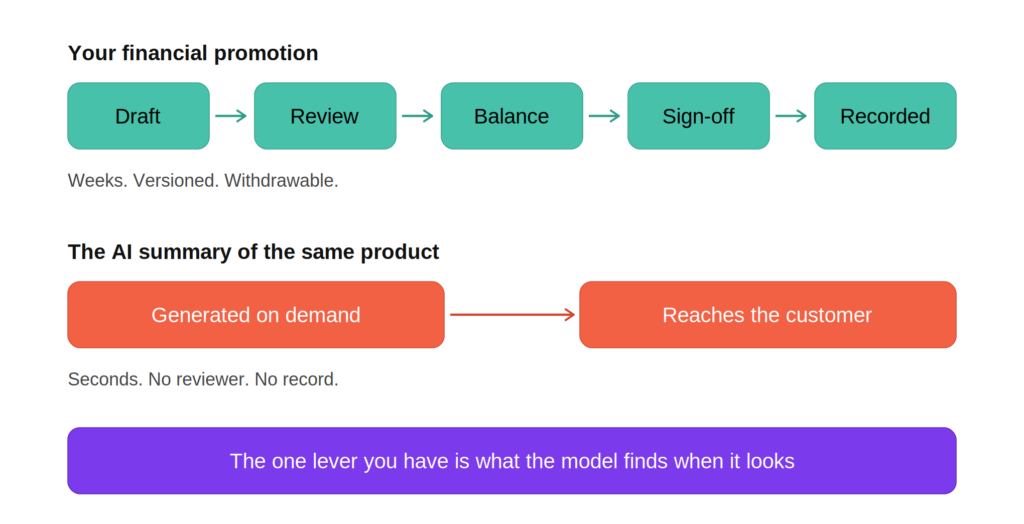
You can’t approve that summary, withdraw it, or correct it. You mostly can’t even see it without going to look.
What you can do is shape what the model finds when it goes looking, and that turns out to be a content and information problem rather than a compliance one. Which is probably why it currently sits with nobody in particular.
So why isn’t it finding you?
The reasons tend to be much less dramatic than the problem, and most of them are things you can look at this week.
A lot of your best information is in a picture.
The headline rate lives in a designed graphic, the eligibility criteria sit behind a tab, the comparison table renders in JavaScript. All of which works beautifully for a person reading the page, and almost none of which is available to a system trying to pull a specific fact out of it.
The answer is four paragraphs down.
This one is worth dwelling on, because it’s usually a consequence of doing the job properly rather than badly. You’ve led with context. You’ve included the qualifiers. You’ve balanced benefit against risk the way you’re supposed to. And the actual number ends up somewhere around the fold.
A person scrolls, so this has never been a problem before. A retrieval system is looking for the most useful information quickly, and if it hits your positioning first it may simply never get to the detail that answers the question.
The encouraging part is that the fix is sequencing rather than substance. You’re not changing what you’ve said or removing anything anyone insisted on, you’re changing the order it appears in. In our experience that’s a far easier conversation to have with a compliance colleague than most people expect, because you’re not asking them to give anything up.
Someone else is answering on your behalf.
This is the one with the biggest gap between how it feels and how much it matters.
5W AI Communications ran 31,500 prompts across five AI engines for its Banking AI Visibility Index 2026 and found that three publishers supplied more than two thirds of the citations behind AI answers about banking. The banks’ own websites accounted for less than 7%. The research is American and those particular publishers aren’t the ones that matter to us, but the shape of it travels. Over here you’d be looking at Moneyfacts, MoneySavingExpert, Which?, the comparison sites, the FCA Register and your trade press.
Which quietly redraws what counts as your marketing estate. The most influential page describing your product this quarter might be one you don’t own, didn’t write and haven’t opened in months.
We ran into this with a client not long ago. A major comparison site was showing the wrong rate, and we eventually traced it back to a caching issue on the data feed. A year ago that’s a ticket for someone’s Tuesday afternoon. Now it’s a number being repeated as fact to everyone who asks, while the correct rate sits on the client’s own site, on a page these systems tend to read as marketing and weight accordingly.
“But we’re B2B”
That’s fair, and the Mills Review really is about retail financial services. There’s no sense stretching it to cover ground it doesn’t.
The behaviour does travel, though. Forrester surveyed nearly 18,000 business buyers for its 2026 Buyers’ Journey Survey. It found 94% used AI during their most recent purchase, with generative AI named the most meaningful research source by twice as many buyers as any other.
An intermediary deciding where to place a case isn’t doing quite the same thing as a consumer choosing a savings account, and the protections around them are different. But the underlying question is the same one. Someone is asking a machine to help them make a decision about your product, and what matters is whether the answer includes you, whether it’s accurate, and whether the sources behind it are ones you’d have picked.
That question shows up across every regulated B2B sector we work in, not only financial services, and we’ve looked at it more broadly in AI marketing in regulated B2B industries.
What happens next
The review asks the FCA to look at general-purpose AI models operating outside the regulatory perimeter within three to six months, covering savings, investments, pensions, mortgages and debt. Nobody knows where that will land. The perimeter might be extended, guidance might be issued, or the existing framework might be judged sufficient.
What does seem likely is that this stops being something a few marketing teams are quietly poking at, and becomes a question someone asks you in a meeting. Having an answer that involves actual evidence, rather than a shrug, is worth an afternoon of preparation.
Where we’d start
Nothing here needs a budget, a platform or a vendor, which is part of why it’s worth doing before anyone asks you to.
The most useful thing is simply to run the test properly. Take ten questions your customers or brokers ask before they ever reach you, put them through ChatGPT and Google AI Mode, and screenshot what comes back. Look at who gets named, how you’re described and which sources the answers lean on. It’s an hour, and it usually tells you more than a month of reading about this will.
After that, it’s worth going and reading your own listings. Moneyfacts, the comparison sites, the register entries, anywhere else your products get described. Check they’re right, and then think about whose job it is to keep checking, because at the moment it may well be nobody’s.
And if you only look at one page of your own, make it a product page, read the way a machine would read it. Is the rate there as text? Can you find the answer quickly? Is your FCA status stated plainly, or implied by a logo in the footer? We’ve written up more of the practical side of this in answer engine optimisation in regulated B2B marketing, if it’s useful.
One last thing
Most firms who run that ten-question test find something they weren’t expecting, and it’s rarely that they’re invisible.
More often it’s that a competitor with a smaller budget, a less impressive site and considerably less brand equity is the one being recommended. Not because they outspent anyone, but because their product page answered the question plainly while ours answered it beautifully.
Which is quite a cheering discovery, on the whole. It means this isn’t a spending problem, and it isn’t a rebuild. It’s a noticing problem, and those are the ones we can actually do something about.
Blaze Communication is an independent B2B marketing agency working with regulated financial services firms on search, content and paid media. If you’d like to know how AI search currently describes your firm, get in touch.
The Mills Review is a 147-page report published by the FCA on 6 July 2026, examining how AI could reshape retail financial services by 2030 and beyond. Commissioned by the FCA Board and led by executive director Sheldon Mills, it identifies four systemic shifts and makes seven priority recommendations, the first of which concerns securing and adapting the regulatory perimeter.
Advice-like support is a term coined in the Mills Review to describe highly personalised output from general-purpose AI models that would count as regulated advice if it sat within the FCA’s regulatory perimeter. Because it does not, it is produced without meeting standards on suitability, explainability or accountability.
No. The review makes recommendations to the FCA Board, which will decide whether and how to take them forward. It explicitly does not recommend AI-specific rules, concluding that the existing outcomes-based framework, including Consumer Duty and SM&CR, remains sound.
The Mills Review recommends the FCA complete a review within three to six months of publication into general-purpose large language models operating outside the regulatory perimeter. Based on the 6 July 2026 publication date, that places it between roughly October 2026 and January 2027.
The review is explicitly about retail financial services. However, the buying behaviour it describes is not confined to consumers. Forrester’s 2026 Buyers’ Journey Survey of nearly 18,000 business buyers found 94% used AI during their most recent purchase, so the visibility question applies to B2B lenders and intermediary businesses even where the retail consumer protections do not.